EppsteinFOILS in the FAZ: What lies behind the thinnest metal foils in the world
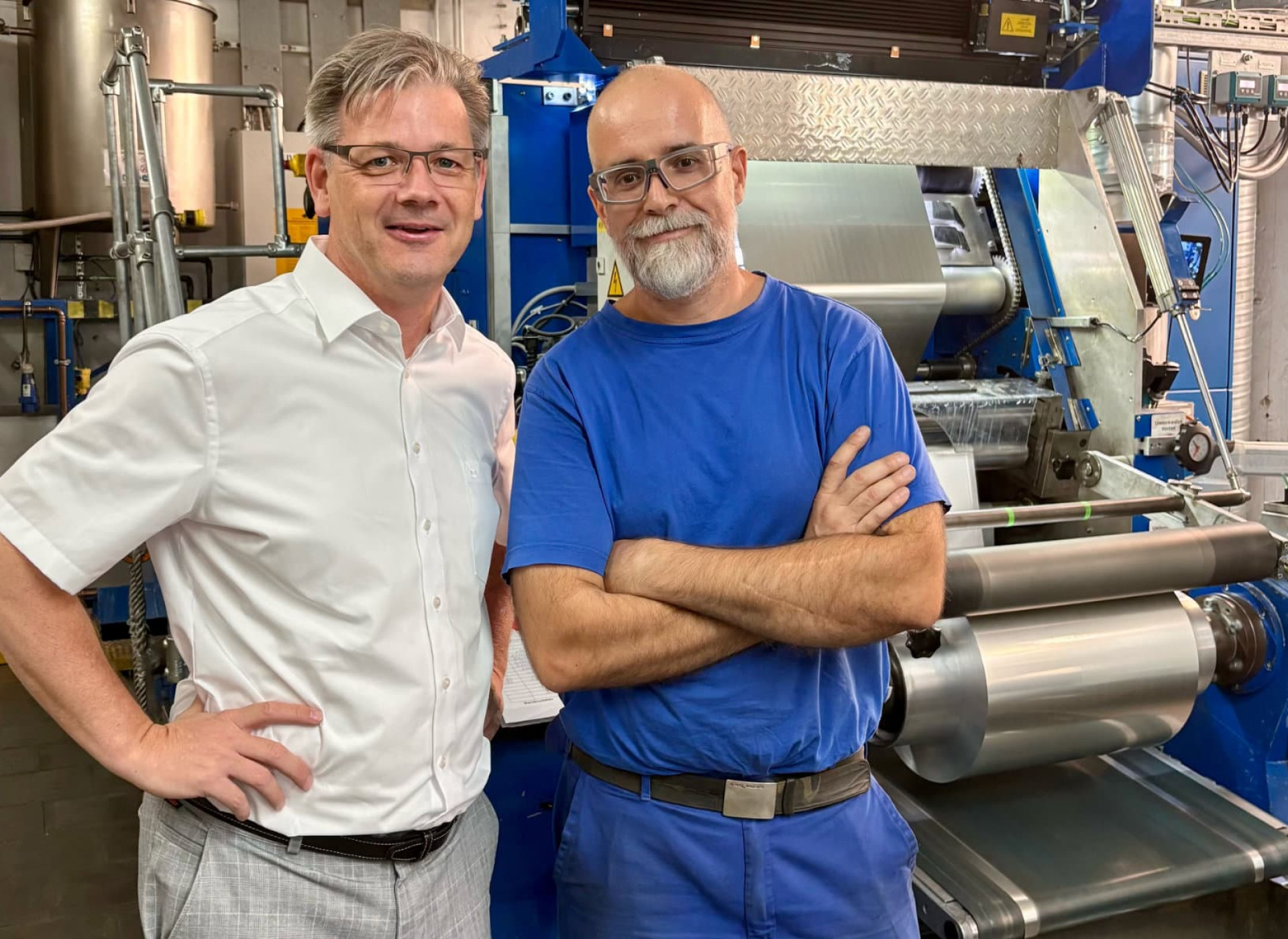
In 2008, the team of the American TV series Mythbusters searched worldwide for a manufacturer who could produce lead foil thin enough to build a flying balloon from it. A lead balloon, mind you. The idea sounds absurd, and that's exactly what the show was about. The problem was less the helium. It was the foil. It had to be 0.02 millimeters thin, uniform across the entire surface, without microcracks, without thickness variations. Worldwide, exactly one company was found that could deliver: ours, here in Eppstein at the entrance to the Lorsbach valley.
The Frankfurter Allgemeine Zeitung recently visited us and published a detailed article. FAZ correspondent Andrea Diener was in our production halls, watched the melting furnaces, was shown the rolling mills, and spoke with our managing director Dr. Marco Holst. We're taking the article as an opportunity to pick up on some of the topics and elaborate on them from our perspective.
What Happens Physically During Rolling
When we roll lead or tin, we press the metal between two hardened steel rollers. With each pass, the foil becomes thinner. That sounds simple at first, roughly like rolling out pizza dough. Except that pizza dough doesn't have a crystalline structure that builds up stresses during deformation. Metal does.
With each rolling pass, the structure of the material changes. The crystallites are stretched, dislocations accumulate, the metal becomes harder and more brittle. At some point it tears. To safely master the process, you have to know it precisely: What thickness reduction is possible per pass? How do the rolling forces develop as the foil thickness decreases? And how does the foil remain dimensionally stable and process-safe throughout the entire rolling process despite progressive cold forming?
We roll foils down to one five-millionth of a meter. At these thicknesses, we're talking about forces in the ton range on a contact area of just a few square centimeters. The rollers themselves deform elastically under this load; they bend minimally. If you don't compensate for this, the foil becomes thicker in the middle than at the edge. Or vice versa. Both would be unusable for our customers, because in materials testing or medical technology, measurement accuracy and function depend directly on thickness tolerance.
That's why we develop and build our rolling machines ourselves. This is one of the reasons why we don't file patents: We don't want anyone to see the construction drawings. The knowledge advantage lies in the machines and in the heads of our people. Or, as Marco Holst puts it in the FAZ: "We buy in kilograms and sell in square meters." The thinner the foil, the more area per kilogram of raw material, the higher the added value. And the more demanding the process.
1500 Tons of Lead, Almost Entirely from Recycling
At the beginning is the melting furnace. At around 600 degrees, we melt lead or tin; the raw material comes almost entirely from recycling. Our own production waste also goes back into the furnace. We cast the liquid metal into ten-centimeter-thick plates, from which the foils are then produced. A single plate can become a foil up to ten kilometers long. You have to imagine that: ten centimeters of starting material, ten kilometers of end product.
We process 1500 tons of lead per year. The melting furnaces stand in semi-open halls facing the courtyard, which makes sense for exhaust air and gives the site its industrial character. Anyone walking through our brick buildings from the 19th century notices: Metal has been processed here for 174 years. The office building, which now houses the administration, is a half-timbered villa from the founding period of 1870. An old engraving in the hallway shows Eppstein at the turn of the century: little village, much factory.
Where Our Foils Work
When people think of lead foil, they might think of tinsel. In fact, we manufactured the product for decades, from 1904 to 2013 on a special machine. The patent for the Christmas decoration comes from our company. Then came plastic tinsel. We focused on what no one else can do.
Today our foils are in applications where precision determines function. Tin foils for defibrillators must have exactly the right conductivity and thickness for energy transmission to be correct. Lead foils in X-ray devices shield scattered radiation; if the thickness deviates, image quality suffers. In non-destructive materials testing (NDT), testing laboratories use our industrial lead foils as reference material to make cracks in pipelines, bridges, and turbines visible. The requirements for foil thickness here are often in the single-digit micrometer range.
And then there are the screw cap seals for wine bottles. Sounds mundane next to medical technology and radiation protection. But here too, it's about material uniformity and processability on high-speed filling lines. In the end, a foil is only as good as its tolerances.
90 People, 18 Nations, a Four-Day Week
In the FAZ, Marco Holst describes our operation as "more of a manufactory." That hits the mark quite well. 90 people work here, 70 of them directly in the production halls. Electricians, locksmiths, machine operators. Professions where experience cannot be replaced by software. Anyone who works here learns things that aren't in any textbook: What does a roller sound like that needs to be reground? What does a foil surface feel like that's just within the tolerance range?
We've had our four-day week for twenty years. It results from the rhythm of the melting furnaces: One furnace filling is enough for two working days, and Fridays are free. In addition, above-tariff pay, a works council, daily allowance for bicycle commuters, and employees from 18 nations. Most stay until retirement.
However, in the past five years, half the workforce has retired. This is a challenge we take seriously. Because with every employee who leaves, knowledge disappears that isn't written down anywhere.
great2know: Experiential Knowledge for the Next Generation
That's why we started the great2know project. A long-time locksmith who helped build the operation is documenting all his machine and process knowledge, piece by piece, detail by detail, as part of a mini-job. Orally, in his own language (which is Hessian), and it all flows into an AI-supported knowledge database. He records every machine, every hand movement, every peculiarity. In the future, our people will be able to access this knowledge directly in the production halls.
This is not an IT prestige project. It's a necessity. If a rolling mill has a quirk that only three people in the operation know, and two of them are retired, then the third needs a place where he can look it up. Or the new person who just started. For a company that maintains its advantage through experiential knowledge and deliberately avoids patents, this project is something like a life insurance policy.
An Article That Makes Our Work Visible
The fact that the Frankfurter Allgemeine Zeitung dedicates a detailed article in the business section to a 90-person operation in the Taunus is not something we take for granted. We consider it an honor that our work is recognized in this context, and we would like to thank Andrea Diener for the careful, sensitive portrait of our operation and photographer Helmut Fricke for the images that have captured our production halls and our work so aptly. Anyone who would like to read the full article can find it here: "Where the World's Thinnest Metal Foil is Produced" (FAZ, July 16, 2026).
And for anyone who prefers to see for themselves: We're located at the foot of Eppstein Castle, twenty minutes from Frankfurt Airport. The melting furnaces simmer Monday through Thursday.